
Online international mentoring program
About
The OHBM Online International Mentoring Program, run by the OHBM Student and Postdoc Special Interest Group (SP-SIG), aims to connect mentors and mentees from around the world together. Applications to this mentoring program includes basic details about the applicant, including their preference for mentors from specific demographic or experiential backgrounds - but not research areas and topics. In this relationship, the mentor supports the mentee in growing their career by providing advice on topics such as - but not limited to - personal development, grant writing, and work-life balance. We also encourage participants to meet in-person during the OHBM Annual Meeting.
Unique to the program is that every member of the OHBM community can be mentored, but also become a mentor. We host young PIs who still seek to be mentored as well as PhD students who volunteer to mentor others. As a rule of thumb, we keep at least 3 years of experience difference between mentors and mentees.
So far, over 1000 participants have taken part in the first four rounds of the program. The participants are gender balanced, and come from all around the world. We observe that over 17% of participants are willing to take part in the program in a double role, as a mentor and as a mentee, which indicates that the participants are willing to contribute and give back to the community for their mentee experience. Trainees are also increasingly keen for mentorship to guide them in considering career opportunities outside of academia and transitioning to industry (broadly defined). Lastly, the expectations and competencies declared by participants around the world are very similar, which is an indication that an online mentorship overseas is necessary and useful.
To find out more about our mentorship program, you can read our position paper published in the European Journal of Neuroscience (Bielczyk, et al., 2018). https://onlinelibrary.wiley.com/doi/full/10.1111/ejn.14320
APPLICATIONS FOR THE 2027 PROGRAM
Responsibilities of Mentors
Mentors play an important role in supporting their mentees' professional and personal development. We encourage mentors to:
Respond to their mentees' messages in a timely manner and communicate openly about their availability.
Meet with their mentees at least once per quarter throughout the academic year.
Provide feedback on one job, fellowship, grant application, or equivalent professional opportunity, should their mentee request it.
Mentors are encouraged to take the opportunity to meet their mentees in person at the OHBM Annual Meeting, if feasible.
Offer guidance in identifying goals and structuring mentoring sessions, particularly when their mentees are unsure what support they need.
Foster a supportive and respectful relationship in accordance with the OHBM Code of Conduct.
Inform the CDMM team of the Student and Postdoc SIG (ohbmtrainees.mentorship.program@gmail.com) at the earliest opportunity if they are unable to continue participating in the program.
Communicate any concerns or potential conflicts of interest to the Student and Postdoc SIG (ohbmtrainees.mentorship.program@gmail.com)
Responsibilities of Mentees
Mentees are encouraged to take an active role in their mentoring relationship and their own professional development. We encourage mentees to:
Initiate contact with their mentor and arrange meetings at mutually convenient times.
Identify their professional development goals and communicate their interests and expectations to their mentor.
Prepare for mentoring sessions by reflecting on topics they would like to discuss.
Recognise that their mentor may not be a subject specialist in their particular research area, but can nevertheless provide valuable career and professional guidance.
Make use of the opportunity to request feedback on one job, fellowship, grant application, or equivalent professional opportunity.
Foster a supportive and respectful relationship in accordance with the OHBM Code of Conduct.
Communicate any concerns or potential conflicts of interest to the CDMM team of the Student and Postdoc SIG (ohbmtrainees.mentorship.program@gmail.com).
Shared Expectations and Scope of the Program
Mentoring relationships are intended to support professional and career development. Research collaboration, co-authorship, supervision, or employment opportunities are not expected as part of the program.
Both mentors and mentees are encouraged to communicate openly about their expectations, availability, and preferred ways of working together.
Mentoring discussions should be treated as confidential. Participants should respect each other's privacy and refrain from sharing personal or sensitive information without consent, except where disclosure is necessary to address concerns relating to safety, misconduct, or applicable OHBM policies.
If a mentoring relationship is not working as expected, participants are encouraged to contact the Student and Postdoc SIG for support. The SIG may facilitate a discussion or consider reassignment where appropriate.
Suggested Discussion Topics
The following topics are intended as a starting point for mentoring conversations. Mentors and mentees are encouraged to identify and prioritise topics that best reflect their interests, goals, and needs.
Career Development
Exploring future career goals and aspirations.
Considering career paths beyond academia, including industry and other sectors.
Navigating career transitions and identifying transferable skills.
Preparing job applications, interviews, and academic presentations.
Developing leadership, mentoring, and supervisory skills.
Academic and Professional Development
Preparing and presenting a poster or talk at the OHBM Annual Meeting.
Building professional networks and navigating conference environments.
Applying for scholarships, fellowships, grants, and other funding opportunities.
Understanding funding systems and academic career structures in different regions.
Developing strategies for publishing and communicating research.
Personal and Professional Well-being
Maintaining work-life balance and managing competing commitments.
Building professional confidence and navigating imposter feelings.
Navigating challenging workplace relationships.
Managing uncertainty and setbacks in academic and professional careers.
Developing strategies for effective communication and collaboration.
Mentoring and Professional Relationships
Identifying and building a professional support network.
Navigating relationships with supervisors, colleagues, and collaborators.
Discussing effective mentorship and supervision practices.
Sharing experiences of career development across different professional and cultural contexts.

Structural of the international mentoring program
Mentoring Resources
Mozilla leadership-training resources: https://github.com/mozilla/leadership-training/blob/master/for_mentors/tip_sheet.md#suggested-reading)
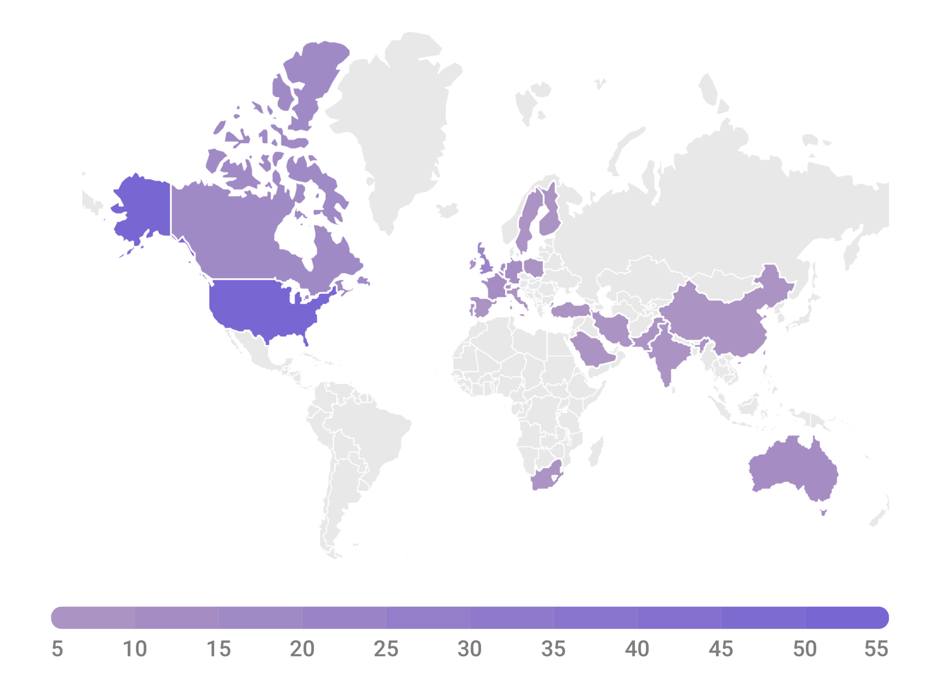
Distribution of the 450 participants in our mentoring program around the world.